Judicial clerkships have long been one of the most prestigious early-career opportunities in the legal profession. That hasn’t changed. What has changed is how clerkships are hired, how predictable the process feels to students and firms, and how clerkship hiring fits into a legal recruiting market that’s moving faster, and earlier.
As firms continue to adjust to compressed timelines and evolving hiring needs, clerkships are poised to play an even bigger role in junior-level recruiting in the years ahead. Here’s a look at how clerkship hiring works today, and why the market may pick up even more than usual heading into 2026.
Clerkships Have Always Been Competitive—and Highly Valued
At their core, clerkships, especially federal clerkships, remain one of the most competitive paths for law students. Judges receive hundreds of applications for a limited number of roles, and those who secure clerkships are usually top academic performers with strong recommendations and demonstrated writing ability.
From the firm side, that prestige carries real weight. Clerks are viewed as highly trained, mature, and immediately valuable hires. They arrive with experience in legal research and writing, exposure to real decision-making, and a strong understanding of how courts operate. As a result, clerks continue to be some of the most coveted junior-level candidates in the market.
That baseline demand hasn’t softened. If anything, it’s becoming more important as firms rethink how and when they hire.
The Clerkship Process Is Less Organized Than It Used to Be
While clerkships themselves haven’t lost their prestige or changed in value, the process for securing one has become more fragmented over time.
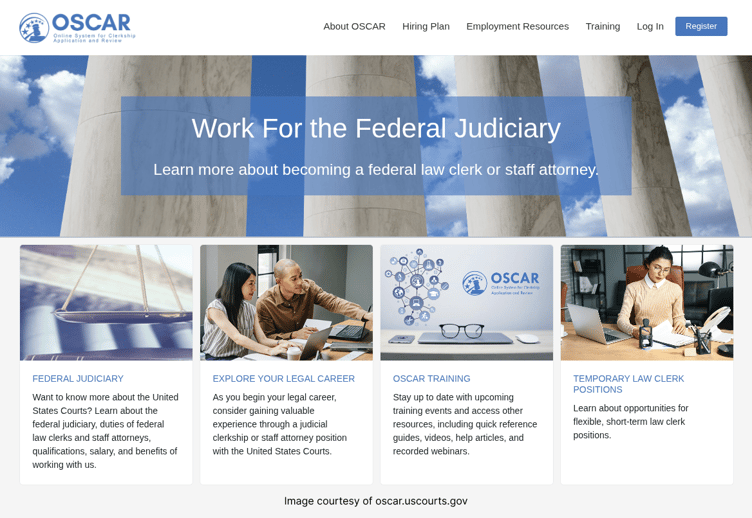
For federal clerkships, OSCAR (the Online System for Clerkship Application and Review) still serves as the centralized platform where students submit applications and judges review candidates. In theory, OSCAR provides structure and transparency to the process. In practice, it can be more complicated.
Some judges follow the federal hiring plan closely, reviewing applications and making offers during designated windows. Others hire earlier, later, or entirely off-cycle, posting openings outside the plan or contacting candidates directly. For students, that means timelines can feel unclear and opportunities can surface at unexpected moments.
This lack of uniformity has made clerkship recruiting feel less predictable, both for applicants trying to plan their careers and for firms attempting to anticipate future hiring pools.
State Court Clerkships Add Another Layer
Federal clerkships get much of the attention, but state court clerkships remain a meaningful, and competitive, aspect of the market.
State courts often hire through decentralized processes that vary by jurisdiction, court, and even individual judge. While these clerkships may be perceived as less competitive than federal roles, they are still highly respected and sought after, particularly in regional markets.
From a hiring perspective, state court clerks bring many of the same advantages as federal clerks: strong writing skills, courtroom exposure, and practical legal experience. As firms broaden their talent strategies, state court clerks are increasingly part of the conversation.
Why Firms Continue to Chase Clerks
BigLaw’s interest in clerks has never wavered. In many cases, it has intensified.
Clerks are seen as lower risk hires with proven skills and strong professional backgrounds. They command high dollar clerkship bonuses, are slotted into advanced associate classes, and are anticipated to be immediately valuable as contributors to their practice group.
In a market where traditional early-career recruiting criteria, like grades and summer performance, are harder to evaluate due to earlier timelines, clerkships provide a clear, trusted credential. That makes clerks especially attractive in an environment where firms are trying to hire thoughtfully despite having less information upfront.
Earlier Recruiting Timelines May Drive More Demand for Clerks
One of the biggest forces shaping the clerkship market heading into 2026 is the broader shift toward earlier recruiting across legal hiring.
Summer associate recruiting timelines have moved to the fall and spring semesters of 1L year, before students have a full set of grades or meaningful law school experience. While that allows firms to secure talent sooner, it also increases the likelihood of mismatches, on both sides.
Students may accept offers before fully understanding their interests or strengths. Firms may make decisions with limited data. Over time, that can lead to more churn, more unmet expectations, and more unfilled or reopened junior-level roles, and while we’re seeing an uptick in 3L hiring, clerks are going to be even more important.
As firms look to fill gaps created by early recruiting mismatches, clerks represent an ideal solution. They are credentialed, experienced, and available at predictable transition points. Clerkship hiring becomes not just a prestige play, but a practical response to the market.

What This Means for the 2026 Market
Taken together, these trends suggest that clerkship hiring in 2026 may be even more competitive, and more active, than usual.
The process is less centralized. The demand from firms remains strong. And the broader recruiting environment is creating conditions where clerks are not just desirable, but necessary.
For students, that means clerkships remain a key option for moving their careers ahead quickly and having a variety of options. For firms, it means staying closely connected to clerkship pipelines and being ready to engage when opportunities arise.
In a market defined by uncertainty, clerkships continue to stand out as one of the clearest indicators of long-term legal talent.