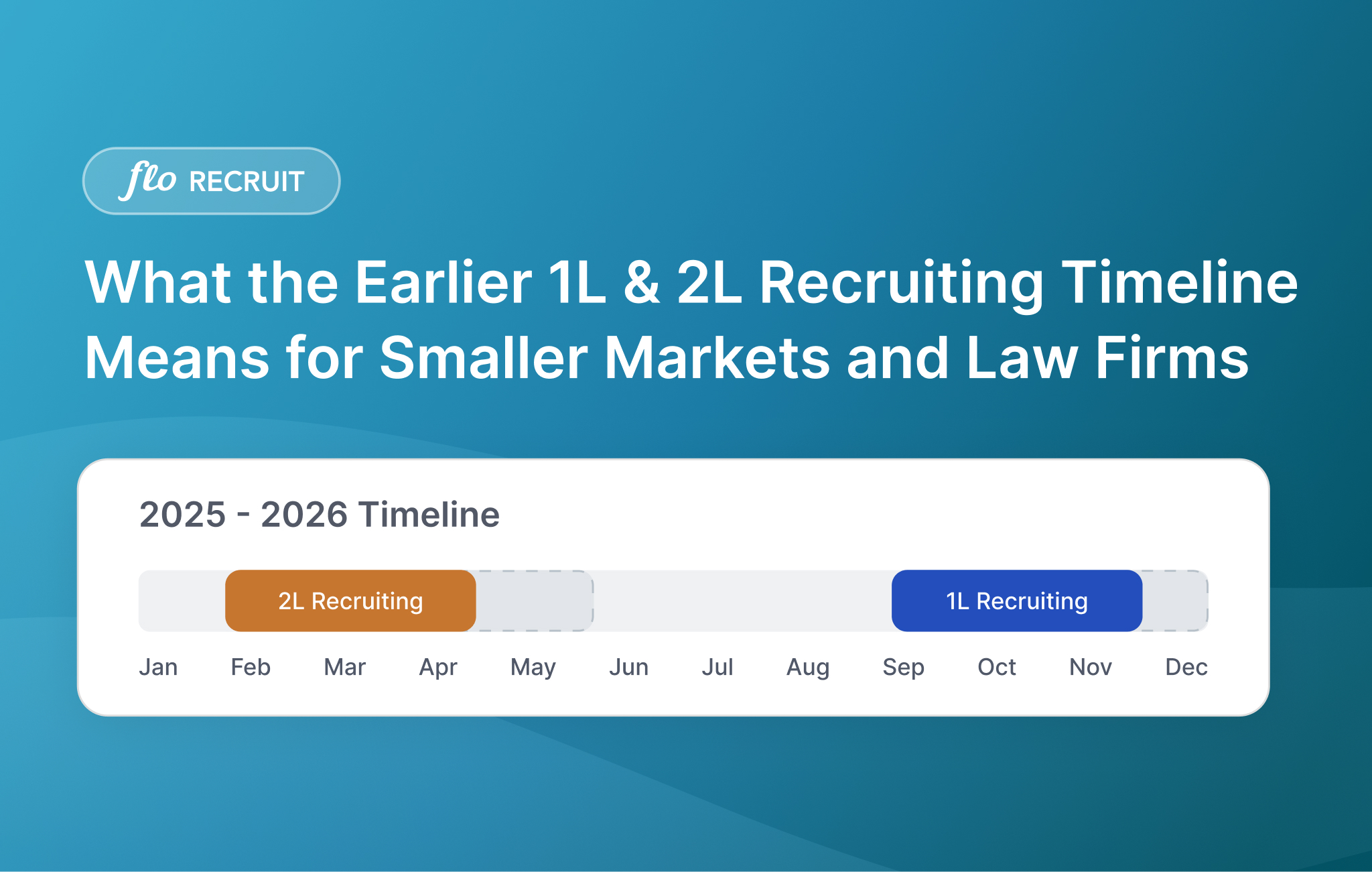
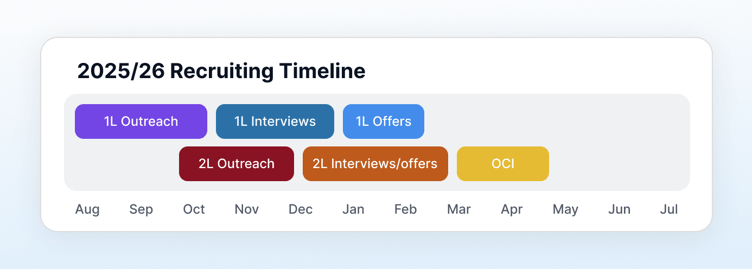
After 5+ years of industry conversation and data monitoring, the legal industry is well aware that law student recruiting timelines are shifting. Since 2018, the process of identifying BigLaw and even midsize firm summer associate candidates has crept earlier and earlier – from roughly July-September in 2022 to April-June in 2025, with talks of a January spike in 2026.
For many firms, this means interviewing students who are barely one semester into law school, or who may not even have a full set of grades yet. The result is a process that feels unfamiliar to anyone who has been in the legal talent world for more than a few years.
While this shift has created challenges for everyone involved, from 1Ls to Career Services to law firm Recruitment departments, it’s also pushing firms to reexamine what “fit” really means and how to identify potential when traditional indicators are no longer enough.
The New Reality: Less Data, More Uncertainty
When recruiting used to happen later in the law school journey, firms could make decisions with more confidence. There were full transcripts to review, on-campus interactions to reflect on, and often more maturity to observe in the candidates themselves. Now, with students entering interviews after only one semester, and sometimes fresh from undergrad, recruiters are working with limited information.
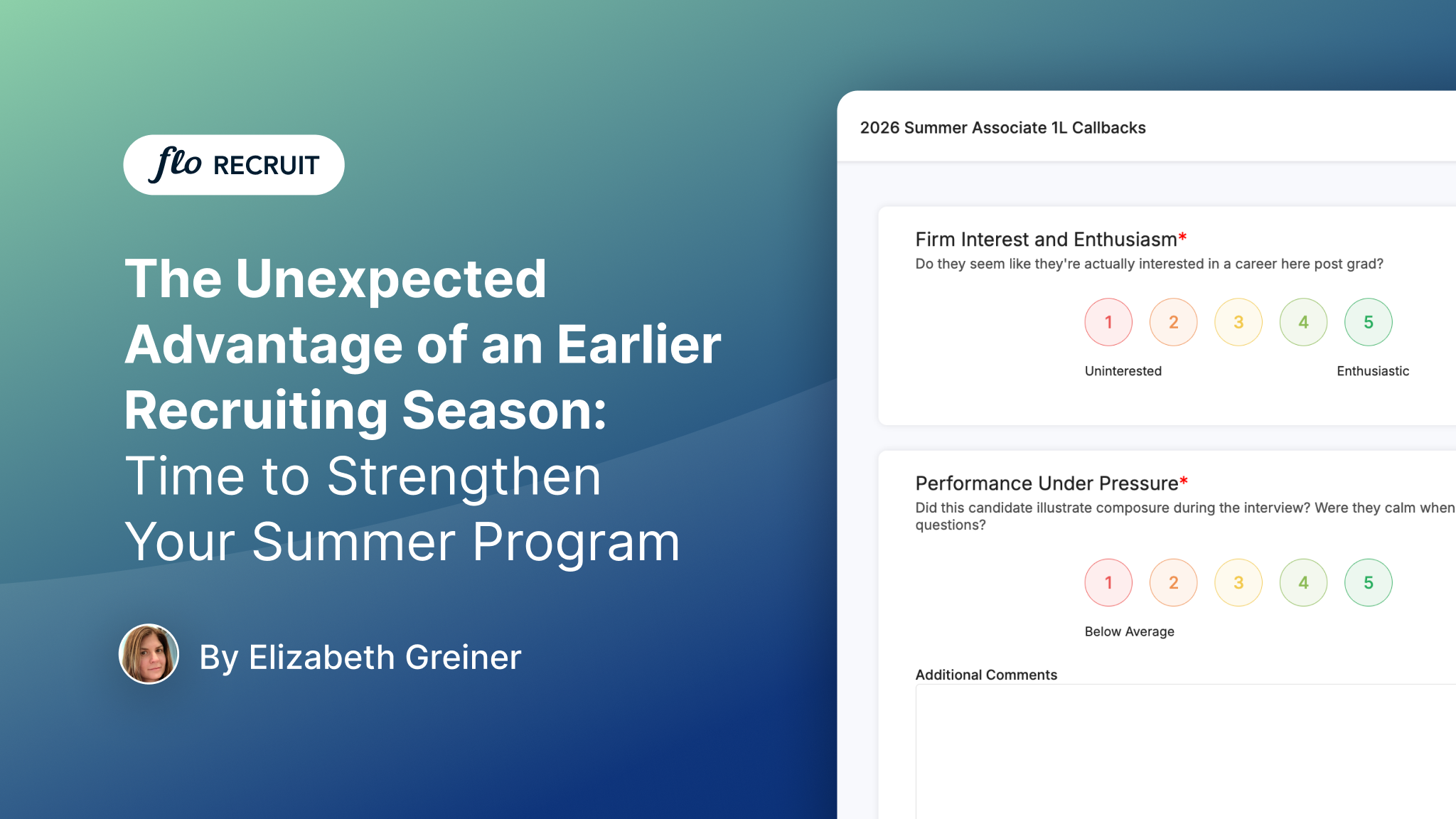
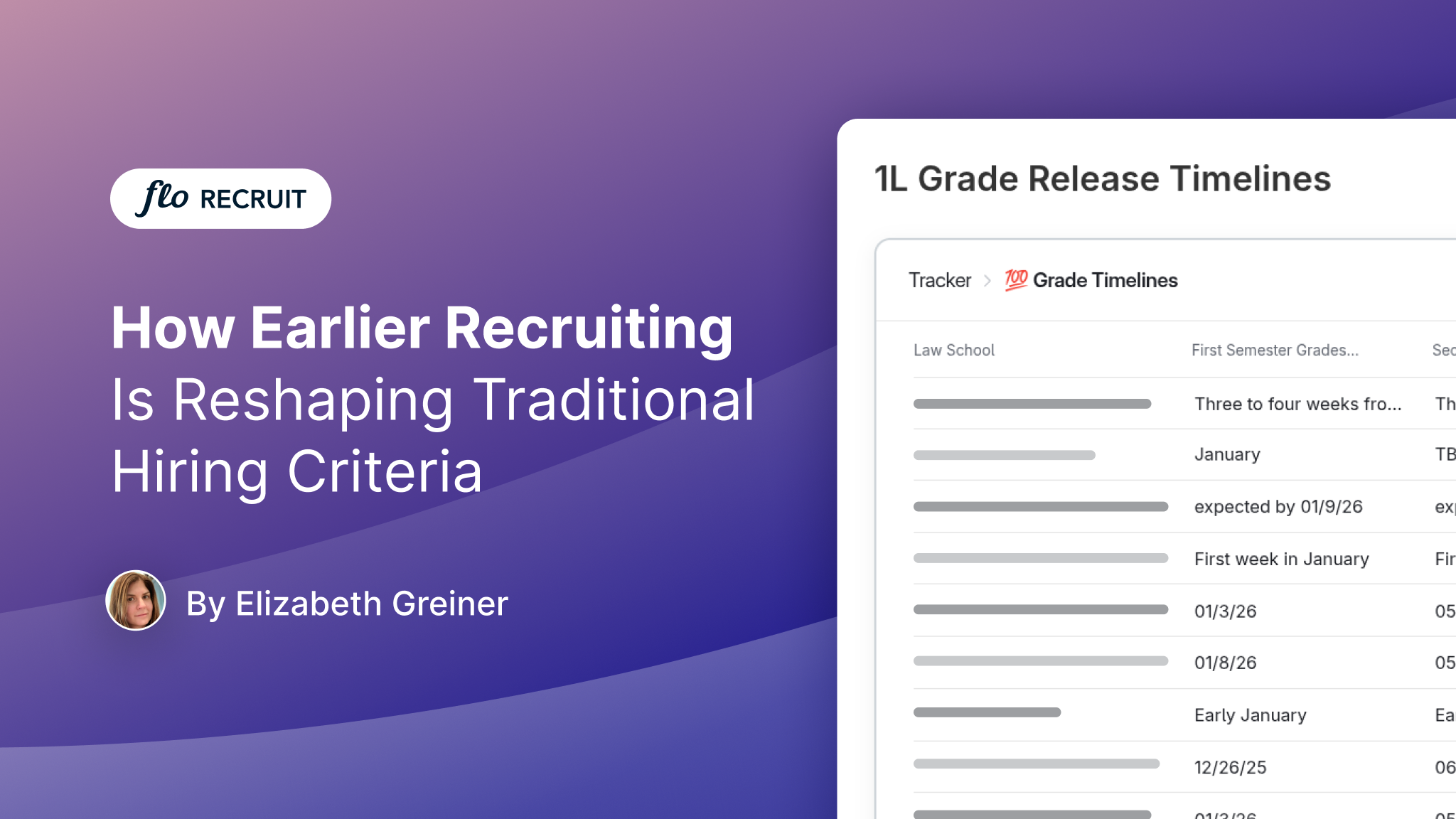
Grades still matter, of course, but when you only have one semester’s worth of them, they can’t carry the same weight. Firms have to acknowledge that a grade earned after just a few months of law school doesn’t yet tell the full story of a student’s capabilities. Similarly, the lack of professional experience, especially for students who went straight from college to law school or are first gen students, means there’s less to point to on a résumé that demonstrates readiness for practice.
The uncertainty can be unnerving, but it’s also a cue: the old metrics don’t tell us enough anymore.
Defining What You're Really Looking For
The first step to navigating early recruiting is to get intentional. What, exactly, is your firm looking for in a summer associate? What does success in that role actually look like?
This is a good time to revisit and clearly define your evaluation criteria. It’s not that grades or law review potential are irrelevant, they just might not be the best predictors at this stage. Qualities like curiosity, motivation, professionalism, and communication skills can be far more revealing.
Encourage your recruiting teams to think about the attributes that truly align with your firm’s culture and client service model. Are you looking for team-oriented problem solvers? Fast learners who thrive under pressure? Students who demonstrate resilience and adaptability? Defining those traits in concrete terms helps interviewers look beyond what’s on paper.
Asking Better Questions
When experience is limited, your interview questions have to do more of the work. Behavioral questions, those that ask candidates to reflect on how they’ve approached challenges, made decisions, or collaborated in the past, can uncover a lot about a student’s mindset and maturity.
For example, instead of asking, “What practice area are you interested in?” you might ask, “Tell me about a time you had to learn something complex quickly, and how did you approach it?” The latter reveals not only how they think, but how they handle ambiguity.
It’s also worth considering how different students’ paths affect their answers. A candidate who went straight through from undergrad may not have the same professional stories as one who spent years in another field. Help your interviewers probe for depth: why did the candidate choose law school? What draws them to your firm? What experiences, even outside of work, demonstrate the skills they’ll need in practice?
Preparing Your Interviewers
With the recruiting window compressed, it’s essential that your interviewers are equipped to make the most of limited time. That means giving them context about what’s changed in the process, what to expect from early candidates, and how to evaluate them fairly.
A short training or briefing session can go a long way. Walk through the specific criteria you’ve identified, share examples of good interview questions, and acknowledge the reality that some uncertainty is inevitable. When attorneys understand the constraints of early recruiting, they’re less likely to rely too heavily on surface-level signals or unconscious biases.
You might also encourage openness in the process itself. Acknowledging to candidates that you know they’re interviewing early, and that everyone is still learning to adapt, can humanize the experience and reduce some of the pressure on both sides.
Building Relationships Earlier
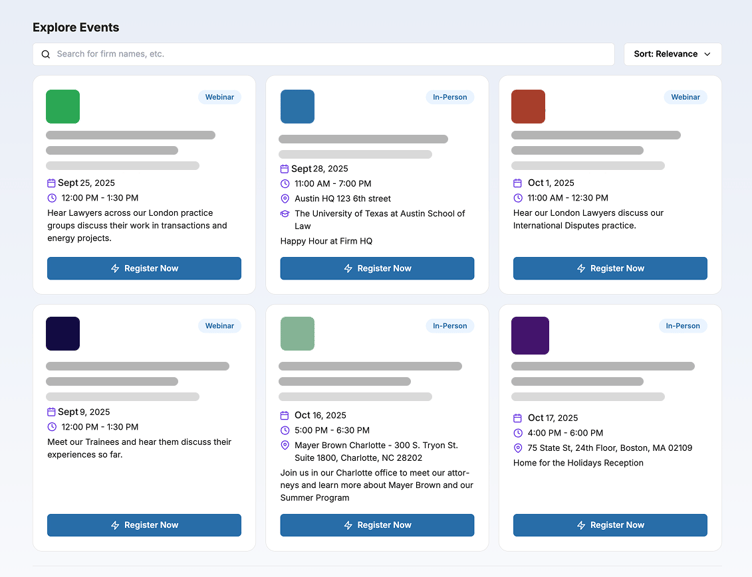
If the formal recruiting cycle is happening earlier, it’s time to move your relationship-building earlier too. Firms that engage with students through events, mock interviews, panels, and informal networking throughout the school year can begin forming relationships before interviewing even arrives.
Those early touchpoints help students get to know your firm in a more informal setting, and they help you get to know them. You might see a student ask insightful questions during a panel, show leadership in a law school organization, or demonstrate genuine enthusiasm about your practice areas. Those observations can be just as valuable as a transcript when it comes time to make decisions.
Redefining Success in an Evolving Landscape
Every firm is facing the same reality: early recruiting comes with risk. With less information, there’s always the possibility of a mismatch. But it also brings opportunity and the chance to rethink what matters most when identifying potential.
By focusing less on grades and more on qualities like judgment, motivation, and cultural alignment, firms can make more holistic, human-centered decisions. And by communicating clearly with attorneys about the new process, setting expectations early, and engaging with students sooner, you can position your firm to adapt, and even thrive, in this new landscape.
Early recruiting does not appear to be going away anytime soon for the largest law firms. But with a thoughtful, flexible approach, firms can navigate it successfully.